
Licensing and certification requirements form a foundational element of professional practice within the skilled trades, and they are particularly significant for a company with Pleune’s breadth of services. These credentials exist not only to meet regulatory expectations, but also to verify that individuals performing highly technical work possess the necessary training and competence to do so safely and effectively. Because each trade operates under its own framework of rules, classifications, and governing bodies, navigating these requirements can be complex. The following overview outlines the types of licenses and certifications relevant to Pleune’s operations and provides context for why they are essential to the integrity of our work and the continued success of our organization.
Both mandatory and voluntary certifications are common in the trades. For HVAC they are required for refrigerant handling, by code for installing or servicing medical gas systems, and mandatory for safety depending on the task at hand. OSHA 10 and 30 are common, and the list of certifications provided by MIOSHA is extensive. The intent behind any certificate is to demonstrate an acceptable level of proficiency and competence for a specific skillset, although most certificate programs do not have universal or objective industry standards.
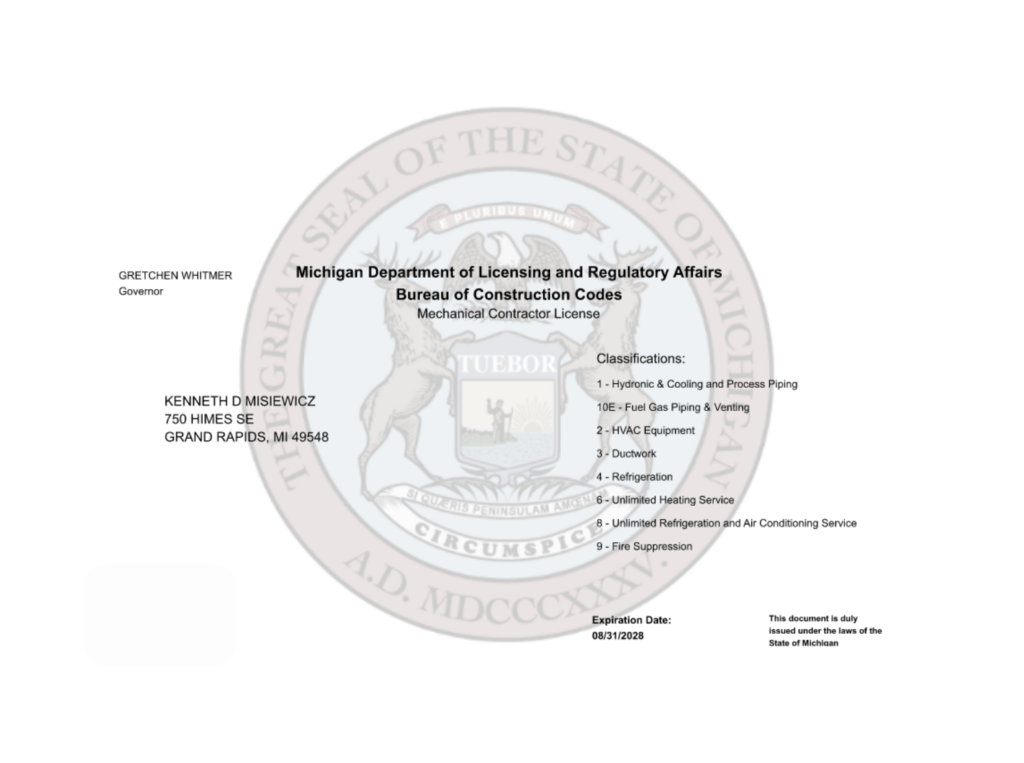
Licensing for HVAC in Michigan is a whole different ball game from any other trade. Unlike other’s licenses, heating, cooling, and/or refrigeration contractors are only allowed to have one mechanical contractor license registered at any given time. That individual license must cover all HVACR classifications the company performs work in, and all employees performing work in those classifications are working under that single license.
Plumbing and electrical licensing are similar to each other, in that they use a system using apprentice registration, journeyman & master licensing, and a separate contractor-of-record license.
Boiler licensing uses a completely different framework which includes five classifications for repair, six levels of classification for installation, a license for non-boiler external piping, and multiple levels of boiler operator registrations; however, there is not a contractor-of-record license for boiler work like there are in mechanical, electrical, and plumbing.
Because every trade Pleune participates in requires licensing and the complexity is ever changing, we have a licensing management process that is reviewed multiple times a year. Career development that leads to becoming a license holder looks different for each trade; however, the need for competence and responsibility combined with a long-term commitment to the organization never changes. Next time we will cover how Pleune Service Company encourages and supports employee owners to earn certificates and licenses that benefit their careers, the company, and ultimately our customers.